A fish death
January 3rd, 2008My seven year old fish died just before New Year’s eve. It is not the first fish that died in my care and it wont be my last. As an aquarist you get used to things like that. One of my consolations is that this particular fish lived out its full life span. At least according to the books.
Some friends of mine bury their dead fish in the backyard or throw them into the garbage dump. Some even put them inside bottles filled with formaldehyde.
This particular fish, Gary the Giant Gourami, eventually ended up on a plate - fried as the main course of a dinner at the house.
Oh well Gary the Gourami lived a full life. Now the two shubunkins are in the tank. Time to look for a new fish.
Christmas at Aquariums
December 24th, 20071951: An Aquarium in California
And for something more contemporary and Aquarium in Japan
Merry Christmas and Happy Holidays!
Giants Clams at Pico de Loro in Hamilo Cove
November 22nd, 2007
The trip lasted for three hours - from Manila to Pico de Loro, Hamilo Cove, Nasugbu, Batangas. We were just able to make it to the event: Giant Clam Seeding at Hamilo Cove.
Giant Clam the Tridacna sp can be seen through out he Philippines. The shell at least. On certain Churches you see them being used as the basin for Holy Water seen near the entrance.
And not a long time ago it was viewed that the Giant Clams could trap a diver’s legs. Nothing could be further from the truth.
The Giant Clams are probably one the most beautiful bivalves in the Sea. Their mantle come in many electric colors - green and blue to name a few.
The Giant Clam has been over harvested to extinction that is why it is on the Convention International Trade in Endangered Species (CITES)’ list and fortunately that is the reason why for years there have been efforts of culture Giant Clams. And the Philippines through the UP-Marine Science Institute has been one of the more successful groups in culturing the different species of Giant Clams like Tridacna gigas, Tridacna squamosa, and others in Bolinao, Pangasinan.
The UP MSI has been so successful that they have bred beyond the F2 or second generation of Giant clams. And for years they have have been reseeding or establishing Giant Clam beds or gardens through the Philippines.
The breeding program was so successful that they were trying to market the different uses of Giant clams (the less endangered species)both for commercial, practical and ornamental purposes.
And this is where I first cross-path with Giant Clams. Together with the people of MSI our aquarist group were interacting with the different uses and monitoring of the Giant Clam trade in the Philippines.
So it was nice to see Dr Susan Licuanan and the World Wildlife Fund again after so many years. And to see that the Giant Program is still doing well.
And although we only spoke briefly during the event it was interesting to note that at Hamilo Cove there are still wild strains of Giant Clam.
It would be interesting to snorkel at Pico de Loro in Hamilo Cove sometime in the future.
Shubunkin and a hydrometer
November 19th, 2007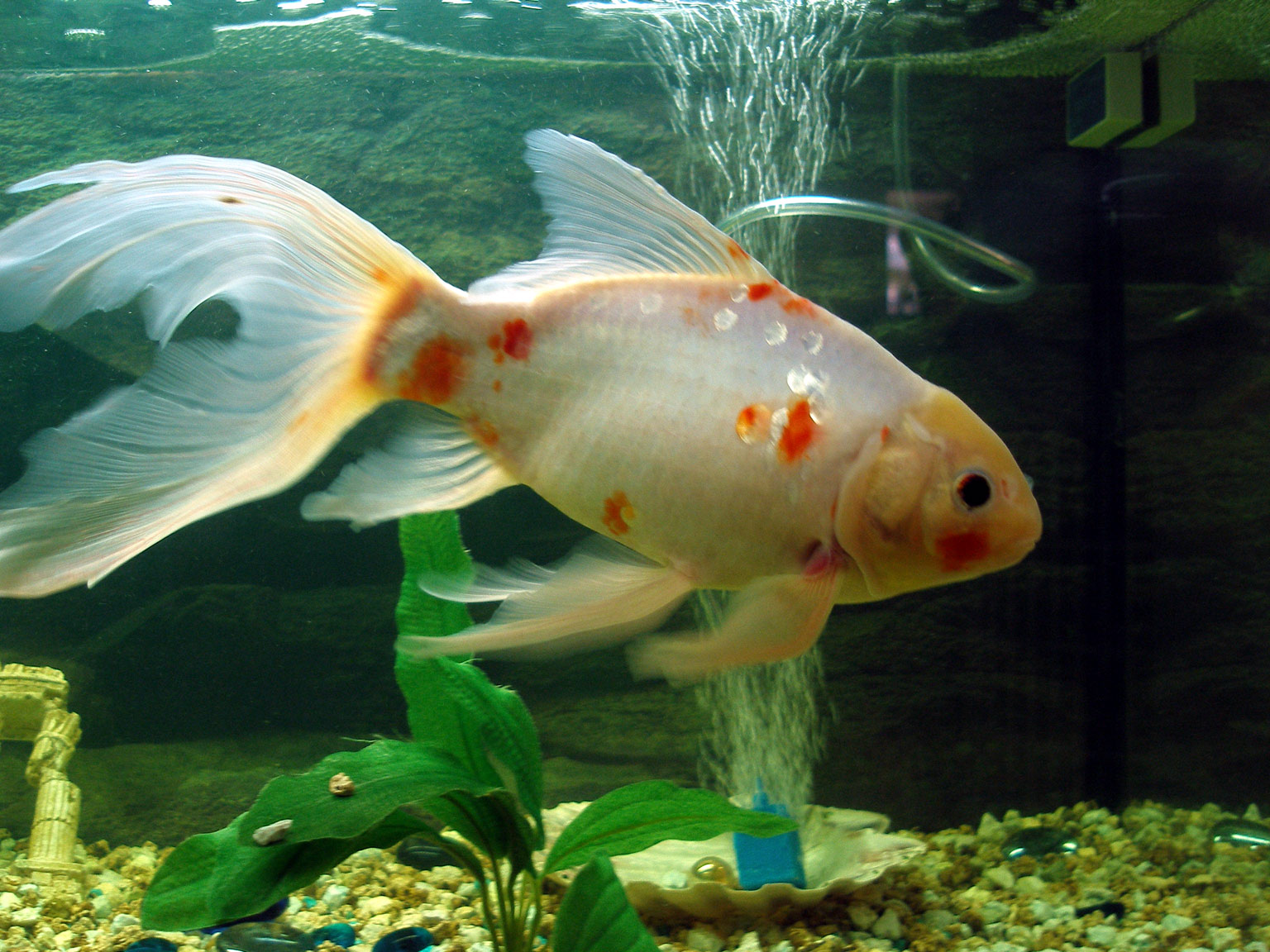
This a picture of seven year old Shubunkin, a single tail goldish that was first bred in Japan. Picture was borrowed from Wikimedia Commons.
Bought two of them Sunday afternoon. Along with a hydrometer for the saltwater tank. I like Goldfishes. They require a large volume of water or well filtered water. In China, they are able to keep them in fish bowls - which they clean everyday. Another more practical way was to put them into vats. The larger the volume of water the better.
Two Shubunkins in a 50 g tank.
And a hydrometer for the Saltwater tank.
Ocean Park Manila Bay
November 12th, 2007It is finally going to happen. This is a plan that stretches decades and it is a long awaited one. And it is soon to open. From what I have heard through the grapevine and from their website. This is going to be an interesting public aquarium.
First, It is going to replicate the flow of water ecosystem from freshwater to saltwater. Each section or biotope bears the following title and themes:
Agos
Bahura
Buhay na Karagatan
Pating
Ang Kailaliman
Laot
Second, Its main attraction is a 25-meter long, 220 degree curved acrylic walkway tunnel.
Third, It has two Open Water Marine Habitats that people can snorkel and dive in. I am assuming and hoping the operators have in place a good filtration system for the habitats.
Fourth, The Oceanarium has a complement commercial, events and hotel complex that comes with a dinning hall that gives its a dinner a spectacular view of the Manila Bay and a select number of guests will have rooms with a wall of aquarium. This is so Dr No I love it.
OK its obvious I am so ecstatic about the project. Hey I am a Filipino Aquarist and I am quite happy that this is happen at last. Its here at last and will open in April 2008. Addendum: A friend of mine told me it is going to open this December (?). If so hurrah hurrah
BTW
Manila Ocean Park will be operated and owned by China Oceanis Philippines Inc., which is a subsidiary of the Singaporean-registered firm China Oceanis Inc. that has operated four oceanariums in China.
Blog Action Day Post from an Aquarist
October 15th, 2007Aquarium Keeping and the environment. What can one say? And what can one not say? There are several issues dealing with aquarium and pond keeping and the environment.
1) Remember an aquarium and a pond is an environment. So practice responsible fish keeping and keep everything in balance.
2) One issue that has plague the aquarium industry is cyanide fishing of saltwater fishes. Do not buy fish caught with cyanide.
3) Endangered species. Do not buy endangered fishes. No matter how tempting or alluring the aspect of keeping one.
4) Always remember to be mindful of Mother Nature. We only have one planet.
5) I do not know if you notice it but if you view history. Human civilizations like those in South America collapse when their environment is abused. Then a few hundred or thousand years later Nature heals itself. We may not realize it but being eco-friendly is actually more for our benefit than for Mother Nature.