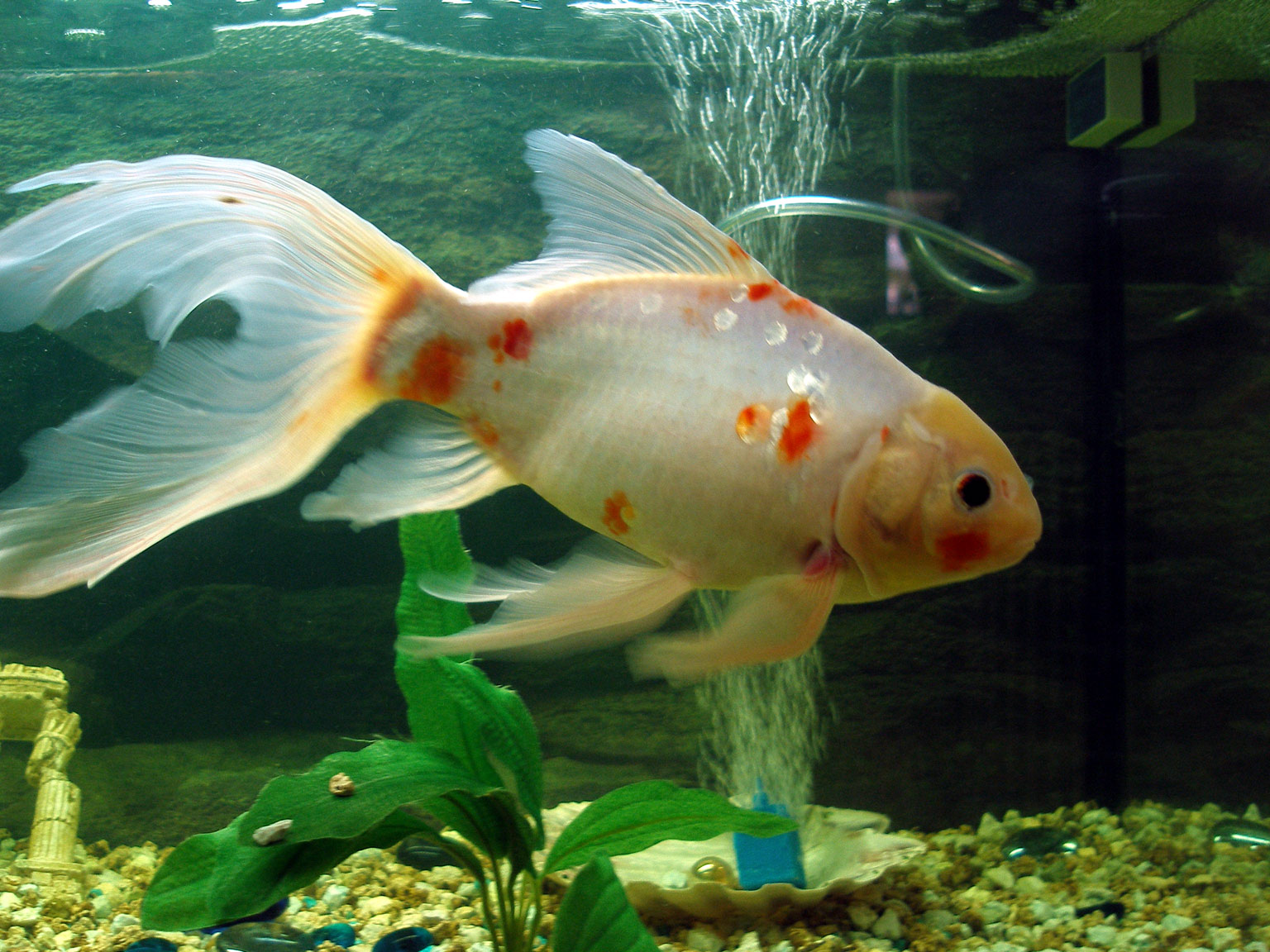
This a picture of seven year old Shubunkin, a single tail goldish that was first bred in Japan. Picture was borrowed from Wikimedia Commons.
Bought two of them Sunday afternoon. Along with a hydrometer for the saltwater tank. I like Goldfishes. They require a large volume of water or well filtered water. In China, they are able to keep them in fish bowls - which they clean everyday. Another more practical way was to put them into vats. The larger the volume of water the better.
Aquarium Keeping and the environment. What can one say? And what can one not say? There are several issues dealing with aquarium and pond keeping and the environment.
1) Remember an aquarium and a pond is an environment. So practice responsible fish keeping and keep everything in balance.
2) One issue that has plague the aquarium industry is cyanide fishing of saltwater fishes. Do not buy fish caught with cyanide.
3) Endangered species. Do not buy endangered fishes. No matter how tempting or alluring the aspect of keeping one.
4) Always remember to be mindful of Mother Nature. We only have one planet.
5) I do not know if you notice it but if you view history. Human civilizations like those in South America collapse when their environment is abused. Then a few hundred or thousand years later Nature heals itself. We may not realize it but being eco-friendly is actually more for our benefit than for Mother Nature.
The Aquarium fish and other denizens of your tiny microcosm lives in a fragile world - like us - and left alone would surely die. An Aquarium is dependent on its owner for its survival. In nature bodies of water and its inhabitants can survive nearly independently from man because water is in constant change or motion (evaporating and raining to cite a few) resulting in removal of old water and addition of fresh water. What does this do? It removes and lessens the amount of pollutants and other harmful substance in the water.
In an aquarium this is not effectively possible.Sure water evaporates but its not enough to lessen the amount of pollutants in the water. In fact if left un-replenished it might be more dangerous, since the level of pollutants will increase due to the decrease in total volume.
In other words your courting danger if your not changing water.
Things to remember when changing water:
Things to prepare before changing water
1) Stock and prepare water that will replace water taken out. This is important since the “new” water will need to be the following: (i) free from chemicals used in treating the water; (ii) Almost the same as the old water chemically and temperature - this is done to avoid shocking the fish with new water parameters or qualities that may lead to shock - temperature and chemical - and eventually death. So two things to remember why you need to stock aquarium water:
- Treat and remove harmful chemicals from the water
- Avoid temperature and chemical shock that may result from the difference between the new and old water,.
2) In case of emergency situation water can be treated with chemical that removes the chorine and chlorine compounds in the water.
When to Change the water
There are three general ways or schemes of changing water : Daily, Weekly or forthnightly (every two weeks).
Daily is good for small aquariums or aquariums with heavy eaters. One half to a complete water change is done
Weekly is good for medium sized aquarium from 20 gallons and up. Although bigger aquarium will benefit from frequent change as well. Usually. One-third of the total volume is changed.
Fortnightly is can be done but water change is usually at fifty percent of the total volume.
Note :
Do not use soap in cleaning the aquarium. Soap and detergents are T-O-X-I-C.
Always have your anti-chlorine and other water treatment kits available.
Rarely do you change the total amount of water - since this will lead to shock.
Hi! This is a new project for this blog - an Aquarium Manual. It will have its own category within this blog. Any aquarist or aquariium hobbyist worth his salt would know the learning process we all went through. The amount of time, money and lives (aquarium denizen) used up is sometimes legendary. I once went to friend’s house to help the family sort out his aquariums and just outside his room was large pile of giant clam shells. Hopefully, this manual will help you select, maintain, and enjoy the aquarium with minimum stress. (more…)
There are several aquariums in the world. All types and sizes exsist from the Betta jar in Thailand to a Lake Victoria tank somewhere in Brisbane or a Jelly fish aquarium in the London Aquarium or the Shark Tank at Sentosa Aquarium. The possibilities are nearly endless. (more…)
Metro Manila and nearly the whole Luzon lost power with the onslaught of typhoon Milenyo or Xangsane. According to the latest news reports, electrical power in Metro Manila will be fully restored by Sunday (according to Meralco). So how are your fishes and aquariums? So far I have no casualty nor problems. Fishes in the ponds and in the aquarium seem to be doing well: So far no fish kills. The presence of plants the stocking rate could be the reason the fishes are doing well. Nearly all of my tanks and ponds are extensively stocked or have a well developed natural filter system, ie plants. (more…)
Imagine keeping an aquarium during the time of the Aquino Presidency. Specifically the time when brown outs lasted for more than eight hours every other day. A friend of mine eventually had to hand-pump air into his reef tank for the whole night (or so he claims). Another friend invested in a generator while another bought a battery and an inverter. It seem almost hard to believe that those things happened. The number one joke at that time was what did the Filipinos used before the candles and the gas lamp? Answer, electricity.
Still it did its mark on a lot of aquarist. More wiser by the experience.
I have written down somethings that could be done in case a brown out happens or went the power goes out. (more…)